In everyday language, the term “perfume” is often used generically to refer to various types of fragrance compositions, ranging from perfume extract to eau de toilette or eau de parfum. However, there is a fundamental difference in concentration between eau de toilette and eau de parfum.
With a direct impact on the product’s intensity, longevity, application, and price, the concentration of different perfume formulations is therefore an essential criterion when choosing an eau de toilette, eau de parfum, or perfume extract for yourself or as a gift. Le Studio des Parfums teaches you how to distinguish eau de toilette, eau de parfum, and parfum extract by smell.
What is a “perfume”?
A blend of essential oils and other natural and/or chemical substances forms what is known as a concentrate in the world of perfumery. This concentrate is at the heart of the production of eau de toilette, eau de parfum, and perfume extracts.
The concentrate is then combined with a carrier, in this case ethyl alcohol, in which it is diluted to allow for better diffusion of its fragrance. The ratio of fragrance concentrate to alcohol in a perfume is not subject to any official regulations, which is why the composition of an eau de toilette or perfume can vary significantly from one perfume house to another.
Eau de toilette: a blend of freshness and lightness
Delicate and understated, eau de toilette is characterized by a concentration of fragrance essence that typically ranges from 7% to 10%. It subtly scents the skin while leaving a decidedly pleasant trail. In this sense, the production of eau de toilette resembles that of the timeless eau de Cologne, which contains an average of 2 to 7% aromatic ingredients and whose notes evoke freshness and cleanliness.
Eau de toilette is frequently compared to eau de parfum. Because its notes are more fleeting than those of its competitor, it is particularly favored during the summer season, while eau de parfum is more of an everyday product.
Eau de parfum: a long-lasting fragrance
More volatile than perfume extract but longer-lasting than eau de toilette, eau de parfum is undoubtedly the perfect compromise. Its formulation requires approximately 10 to 20% perfume concentrate and 90% alcohol by volume, whereas eau de toilette is made with 80% alcohol by volume.
Eau de parfum can be worn throughout the day. It lasts on the skin for about 6 hours, compared to 3 to 5 hours for eau de toilette. These two fragrances can also be applied in addition to perfume extract for a more intense scent trail.
Perfume extract: a highly sensorial concentrate
Perfume extract is undoubtedly the most concentrated form of all. In a way, it embodies perfume in its purest form. A master perfumer actually needs about 20 to 40% of raw materials diluted in 90% alcohol by volume to create an authentic perfume extract.
Unlike eau de parfum or eau de toilette, perfume extract is formulated without water, which accounts for its characteristic elegance and intoxicating intensity, derived from heart and base notes that rival each other in power. Although particularly expensive, perfume extract is less popular in perfumery than eau de parfum.
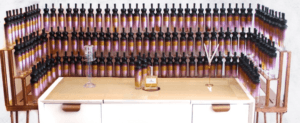
In our studio, eau de parfum is not merely a combination of delicate scents. It also symbolizes a true experience, as our bespoke creation workshops offer you the opportunity to design the eau de parfum of your dreams using the 100 exclusive notes from our iconic perfume organ. Thanks to the Studio des Parfums, experience a timeless moment in the heart of the Marais.